
What Should I Pay My Vacation Rental Cleaner? 2026 Rates
How much should you pay your vacation rental cleaner per turnover? 2026 rates by property size, flat vs hourly pricing, and fair cleaner pay.
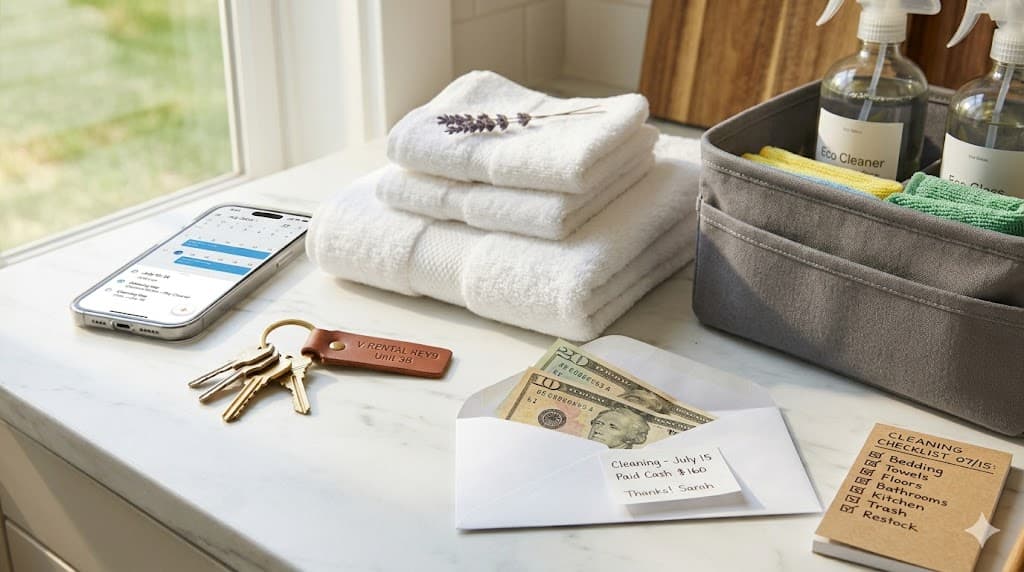
If you manage a vacation rental on Airbnb or VRBO, your cleaner is probably the most important person in your operation besides you. A great cleaner protects your reviews, keeps guests happy, and saves you from the kind of phone call no host wants to get: "We arrived and the place wasn't clean."
But figuring out what to pay them, and understanding the true Airbnb cleaning and VRBO cleaning cost behind each turnover, can feel like guesswork if you've never hired a turnover cleaner before. You don't want to underpay and lose a good cleaner. You also don't want to overpay relative to what your market supports. This guide breaks down what vacation rental cleaners actually earn in 2026, how to structure your pay arrangement, and how to build a cleaner relationship that lasts.
How Much Do Vacation Rental Cleaners Charge Per Turnover?
Most vacation rental cleaners in the United States charge a flat rate per turnover, meaning a fixed price to clean and reset the property between guests. Here's what that looks like by property size in 2026:
| Property Size | Typical Range (USD) | National Average |
|---|---|---|
| 1 bedroom / studio | $40 – $90 | ~$55 |
| 2 bedrooms | $50 – $130 | ~$75 |
| 3 bedrooms | $70 – $175 | ~$100 |
| 4 bedrooms | $100 – $225 | ~$140 |
| 5+ bedrooms | $150 – $350+ | Varies widely |
These are what the cleaner receives, not what you charge guests as a cleaning fee. We'll cover the difference between those two numbers below.
A few important notes on these ranges. Location matters enormously: a 2-bedroom turnover in Scottsdale, Arizona or Maui, Hawaii will cost more than one in rural Tennessee. Properties with hot tubs, pools, multiple living areas, or extensive outdoor spaces push toward the higher end. And "turnover" scope varies: some cleaners just clean while the host handles laundry and restocking, while others do the full reset including linens, amenity restocking, and a property condition check.
Canadian hosts: Rates in Canadian vacation rental markets tend to track slightly lower than comparable US markets when expressed in CAD. In high-demand areas like Whistler, Tofino, or Muskoka, expect turnover rates comparable to upper-tier US resort markets. Remote properties often carry a premium because of cleaner travel time.
Should You Pay Your Cleaner Hourly or a Flat Rate Per Turnover?
For vacation rental turnovers, a flat per-turnover rate is the industry standard, and for good reason.
Flat rates give both sides predictability. You know exactly what each turnover costs when you're modeling your nightly rate and cleaning fee. Your cleaner knows exactly what they're earning per job, which helps them plan their day across multiple properties. There's no clock-watching, no disputes about whether a job took two hours or three.
The alternative: paying hourly: makes more sense for deep cleans, seasonal opening/closing, or unusual jobs (post-party cleanups, for example). For routine turnovers, hourly rates introduce friction. A same-day turnover with a 4-hour window doesn't leave room for the cleaner to take their time and bill by the hour.
That said, it's worth knowing the effective hourly rate behind your flat rate. If you're paying $75 for a 2-bedroom turnover that takes about 2.5 hours of hands-on work, your cleaner is earning roughly $30/hour, a solid rate for independent cleaning work. If that same job takes 4 hours because the scope has quietly expanded (more beds, more bathrooms, more restocking), the effective rate drops to under $19/hour, and you should renegotiate.
Airbnb's own hosting resources suggest a minimum of $25/hour for self-employed cleaners and $15/hour for cleaning company employees. Most experienced vacation rental cleaners in active STR markets effectively earn $25–$50/hour when you divide their flat rate by actual cleaning time.
What Factors Affect How Much You Pay?
No single number works for every property. Here are the factors that move the needle:
Property size and layout. More bedrooms, more bathrooms, more square footage, more time. A 3-bedroom with one bathroom cleans faster than a 3-bedroom with three. Multi-level properties take longer than single-story ones.
Scope of work. Does your cleaner handle linens (stripping, washing, drying, remaking beds)? Are they restocking toilet paper, soap, shampoo, coffee, and kitchen supplies? Are they doing a property condition report: checking for damage, reporting maintenance issues, photographing anything unusual? Each added responsibility justifies higher pay. Your cleaner isn't just cleaning; in a well-run vacation rental, they're your on-the-ground property manager between guests.
Location and cost of living. Cleaners in high cost-of-living markets (coastal California, Hawaii, Colorado mountain towns, South Florida) charge more than those in lower-cost areas. This isn't just about the cleaner's expenses, it reflects local labor market competition too.
Travel time. In remote or rural vacation rental markets, your cleaner may drive 20–45 minutes each way to reach your property. That travel time has real costs (fuel, vehicle wear, and time they could be cleaning another property), and it's reasonable for it to be reflected in their rate, either as a higher flat rate or an explicit travel surcharge.
Same-day turnovers. A clean with a comfortable window (checkout at 11 AM, check-in at 4 PM) is easier on your cleaner than a same-day crunch where checkout is at 11 and check-in is at 3. If your booking patterns regularly create tight turnovers, you're asking your cleaner to prioritize your property and work under pressure. That's worth paying for. Some cleaners charge a rush or same-day premium, and they should.
Seasonal demand. Peak season means your cleaner is in higher demand and working harder. If you're fully booked every weekend from June through September, your cleaner is too. Rates that work in the shoulder season may need a bump during peak weeks.
Supplies and equipment. If your cleaner provides their own cleaning products and equipment, that cost is built into their rate. If you supply everything, the rate can be lower. Either arrangement works, just be clear about it upfront.
What About Add-On Charges for Extra Work?
Your cleaner's base turnover rate covers a standard clean, but not every turnover is standard. Certain situations require extra time and effort, and your cleaner should be compensated for them.
Common add-ons that warrant extra pay:
Pet cleans. If your property is pet-friendly, turnovers after guests with dogs (or cats, or anything that sheds) take meaningfully longer. Extra vacuuming, lint rolling furniture, checking for accidents, and sometimes dealing with fur embedded in bedding. Many hosts set a flat pet cleaning surcharge, typically $15–$40 on top of the base rate, and pass it through to the guest as part of a pet fee.
Extra guest bed setup and teardown. If your property accommodates additional guests on sofa beds, air mattresses, or fold-out beds, that's real physical work: making up extra beds with fresh linens before check-in, then stripping and laundering after checkout. This is especially relevant for larger properties where the 7th and 8th guest trigger spare bed setups. A per-bed add-on of $10–$25 is reasonable and easy to pass through to the guest as a per-person fee.
Deep cleans. Beyond routine turnovers, every vacation rental needs a periodic deep clean: inside appliances, behind furniture, grout scrubbing, window washing, baseboards. These take 2–3x longer than a standard turnover. Schedule them quarterly or seasonally and pay your cleaner accordingly, typically 2–3x the base turnover rate.
Outdoor equipment resets. If your property has a barbecue, fire pit, hot tub, or extensive outdoor entertaining area, post-use deep cleaning goes beyond a quick wipe-down. BBQ grate scrubbing, ash removal, hot tub chemical checks, and patio furniture resets all add time. A per-item surcharge keeps things fair.
The key with add-ons is transparency in both directions. Your cleaner should know before they arrive what extras are expected for each turnover, not discover the sofa bed was used and the barbecue is a mess when they walk in the door. And they should know exactly what they're being paid for each extra task, not just a vague "a little more this time."
This is one of the areas where tracking clean fees in a tool rather than in your head pays off. GleamSync, for example, lets owners set add-on fees as defaults on each property: pet clean, extra beds, deep clean, and then attach the relevant ones to each clean. Your cleaner sees exactly what's expected and what they're earning for each task, and you have a clear record of what you've paid over time. That kind of clarity prevents the awkward "wait, was this supposed to be a pet clean?" conversations.
How Does Cleaner Pay Relate to Your Cleaning Fee?
Both Airbnb and VRBO let you set a per-listing cleaning fee that's charged to the guest on every booking. This is separate from your nightly rate, guests see it as a line item at checkout. It's the easiest way to cover your cleaning costs, and most hosts use it.
But "cover your cleaning costs" raises an immediate question: should your cleaning fee exactly match what you pay your cleaner, or should you build in a margin?
There are two schools of thought, and both are legitimate.
Strategy 1: Flat passthrough. You pay your cleaner $75, you charge the guest $75. The cleaning fee is a pure cost recovery, you're not making or losing money on cleaning. This approach is simple, easy to explain if a guest asks, and keeps your cleaning fee as low as possible (which can improve booking conversion, especially for short stays where the fee is a larger percentage of the total price). The tradeoff: you're absorbing all the other turnover costs: supplies, amenity restocking, laundry, and your own coordination time, out of your nightly rate margin.
Strategy 2: Cost-plus margin. You pay your cleaner $75, you charge the guest $95–$100. The extra $20–$25 covers the real costs that go beyond the cleaner's check: cleaning supplies, guest amenities that need restocking (toilet paper, soap, shampoo, coffee), laundry detergent and machine wear, and your time spent coordinating the turnover. This approach is more accurate accounting, you're recognizing that a turnover costs more than just labor, and it keeps those costs from silently eroding your nightly rate profit.
Which is better? Neither is wrong. But if you're running the numbers honestly, the cost-plus approach usually makes more sense. A typical turnover involves $10–$20 in restocking supplies alone, plus laundry costs, plus platform fees (Airbnb now charges most hosts a 15.5% host-only service fee on the booking total including the cleaning fee, replacing the old 3% split-fee model; VRBO takes roughly 8%, a 5% commission plus 3% payment processing, with the commission applying to the rental subtotal and mandatory fees including cleaning). If your fee is a pure passthrough, you're subsidizing those costs from your nightly rate, which you may not realize until you do the math at tax time.
The one rule that should be non-negotiable: your cleaning fee should never be lower than what you pay your cleaner. It sounds obvious, but some hosts set artificially low cleaning fees to attract bookings and then eat the difference. That's not sustainable, and it puts pressure on you to eventually cut your cleaner's pay, which is how you lose a good cleaner.
Whatever strategy you choose, at minimum your cleaning fee should cover your cleaner's full base rate. Everything above that is a business decision about where you want to absorb the rest of your turnover costs.
Average Airbnb & VRBO Cleaning Fee vs. What You Pay Your Cleaner
The average cleaning fee on Airbnb and VRBO. what hosts charge guests, typically runs $75–$200 depending on property size and market. But the Airbnb cleaning service cost you actually pay your cleaner is a separate number. For a standard 2-bedroom turnover, most hosts pay their cleaner $50–$130 while charging guests $75–$150. The difference covers supplies, restocking, laundry costs, and platform fees. Understanding this gap is key to setting a cleaning fee that's competitive for guests and sustainable for you.
How Do I Know If I'm Paying My Cleaner Fairly?
The simplest test: would your cleaner choose to keep working with you if they had a better option tomorrow?
If the answer is "probably not," you're likely underpaying. Here's a more structured way to check:
Compare locally, not nationally. National averages are useful benchmarks, but what matters is your local market. Ask other hosts in your area, local Facebook groups for vacation rental hosts are a goldmine for this. Check what comparable listings in your market charge as a cleaning fee and work backward.
Calculate the effective hourly rate. Divide your flat rate by the actual hours the clean takes (including laundry time if applicable). If the result is below $20/hour in most US markets, or below $25/hour in high cost-of-living areas, you're probably below market.
Watch for warning signs. When your cleaner starts declining same-day turnovers, when quality gradually slips, when they become harder to reach during peak season, or when they mention picking up additional clients, these are signals that the economics aren't working for them anymore. A good cleaner has plenty of demand. If you're not competitive, they'll prioritize the properties that are.
Ask directly. This sounds obvious, but many hosts never do it. An honest conversation. "Is this rate still working for you? Do we need to adjust?". goes a long way. Your cleaner may have been absorbing cost increases for months without saying anything because they value the relationship.
When Should You Raise Your Cleaner's Pay?
At minimum, once a year. But there are specific triggers that should prompt a conversation sooner:
You've increased scope. If you've added a hot tub, upgraded to king beds with more linens, started offering more guest amenities to restock, or expanded the property, the clean takes longer and costs your cleaner more effort. The rate should reflect that.
Inflation and cost of living. Gas, cleaning supplies, and living expenses all go up. A rate that was fair in 2023 may be below market in 2026. Even a modest 3–5% annual increase keeps you competitive and shows your cleaner you respect their work.
They've demonstrated exceptional reliability. The cleaner who handles your same-day turnovers without complaint, reports maintenance issues before they become problems, and consistently delivers 5-star-ready spaces is worth more than the cleaner you found on Craigslist last week. Pay accordingly.
You've increased your cleaning fee. If you've raised what you charge guests, your cleaner should share in that increase, especially if the raise was prompted by their quality of work or increased scope.
Tips for Building a Cleaner Relationship That Lasts
Finding a great vacation rental cleaner is hard. Keeping one is a matter of respect, communication, and operational support.
Pay on time, every time. This sounds basic, but inconsistent or late payment is the number one reason cleaners leave good clients. Set up a reliable payment schedule: whether that's per clean, weekly, or biweekly. Pre-paying for upcoming cleans is common and perfectly legitimate in vacation rental operations; it shows trust and ensures your cleaner knows they'll be compensated even if a booking cancels last-minute.
Communicate booking changes immediately. Last-minute cancellations, new bookings, date changes, early check-ins, all of these affect your cleaner's schedule. The faster they know, the less disruptive it is. Manual texting works when you have one property, but it breaks down quickly when bookings change frequently or you manage more than a couple of properties. This is where automated cleaning notifications become valuable: your calendar changes, your cleaner gets notified, no one has to remember to send a text. (This is exactly the problem GleamSync was built to solve, syncing your Airbnb and VRBO calendars and sending automatic notifications to your cleaner via email, SMS, or WhatsApp.)
Provide adequate clean windows. A turnover clean window. the time between one guest's checkout and the next guest's check-in, directly affects your cleaner's ability to do quality work. Booking back-to-back stays with 2-hour windows is a recipe for rushed cleans and stressed cleaners. Set reasonable minimum gaps in your listing settings and communicate timing clearly.
Supply good equipment and products. If you expect hotel-quality results, provide hotel-quality tools. Fresh mop heads, quality vacuum, effective cleaning products, and well-maintained washer/dryer equipment all make the job easier and the results better.
Treat them as a partner, not a vendor. In a well-run vacation rental, your cleaner is your eyes and ears at the property. They spot the leaky faucet before the guest complains. They photograph the damage the previous guest left before you review them. They notice when supplies are running low. That partnership is worth cultivating, and it starts with paying them fairly, communicating clearly, and showing genuine appreciation for their work.
Frequently Asked Questions
How much do Airbnb cleaners charge per hour?
Most experienced vacation rental cleaners earn an effective rate of $25–$50 per hour, though they typically charge a flat per-turnover rate rather than billing hourly. Standard hourly rates for STR cleaning services range from $20–$50/hour depending on location and experience. For independent cleaners (not companies), rates tend to be higher than traditional residential cleaning because turnover cleaning requires faster work, higher attention to detail, and on-call availability.
Should I provide cleaning supplies or should my cleaner bring their own?
Either arrangement works, the key is agreeing upfront. Many independent cleaners prefer to bring their own products because they know what works. If you supply everything, you have more control over product quality and scents, and the cleaner's rate can be slightly lower since they're not absorbing supply costs. Common split: host supplies restocking items (toilet paper, soaps, amenities) and major equipment (vacuum, washer/dryer), cleaner brings cleaning products and hand tools.
Do I need to tip my vacation rental cleaner?
Tipping norms for independent vacation rental cleaners differ from tipping a cleaning service. Since independent cleaners set their own rates, the rate itself should be fair compensation, there's no employer taking a cut. That said, many hosts give bonuses during peak season, holidays, or after particularly challenging turnovers. A holiday bonus of one clean's pay is a common and appreciated gesture. If you use a cleaning company, tips for the individual cleaners are appropriate since the company takes a margin.
How much should my cleaning fee be compared to what I pay my cleaner?
Your cleaning fee should be at least 20–30% above what you pay your cleaner to cover supplies, amenity restocking, laundry costs, coordination time, and platform fees (Airbnb now takes a 15.5% host-only fee on the booking total including the cleaning fee for most hosts; VRBO takes roughly 8% total). If you pay your cleaner $75, your cleaning fee should be at least $90–$100. Never set your fee below your total cost floor.
Is it better to hire a cleaning company or an independent cleaner?
Both have tradeoffs. Cleaning companies offer backup coverage (if one cleaner is sick, they send another), liability insurance, and sometimes more consistent quality standards. But they cost more: the company takes a margin, so either you pay more or the individual cleaner earns less. Independent cleaners typically cost less per turnover, offer more personal accountability, and build a direct relationship with you and your property. For hosts with 1–5 properties who value a personal relationship with their cleaner, an independent cleaner is often the better fit, which is the "Bring Your Own Cleaner" approach that tools like GleamSync are designed to support.
Does Airbnb charge a cleaning fee?
Airbnb doesn't set or charge the cleaning fee, hosts do. As a host, you set your own cleaning fee in your listing settings, and that amount is passed on to guests as a line item at booking. It's completely separate from what you pay your cleaner per turnover, which is typically based on property size and scope of work. Airbnb takes a host service fee on the total booking amount including the cleaning fee. For most hosts this is now a 15.5% host-only fee, which replaced the older split-fee model where the host paid about 3% and the guest paid a separate fee at checkout.
How much is the Airbnb cleaning fee? What is the average cleaning fee for Airbnb?
The average Airbnb cleaning fee ranges from $75 to $200+ depending on property size, location, and what's included. Studios and one-bedrooms typically charge $50–$100, two-to-three-bedrooms run $75–$150, and larger homes charge $150–$250+. Keep in mind: the cleaning fee you charge guests and the amount you pay your cleaner are two different numbers: the gap covers supplies, restocking, laundry, and your coordination time.
What is the average Airbnb cleaning service cost?
Airbnb cleaning service costs vary by market, but per-turnover rates typically run $50–$175 for most properties. If you hire through a cleaning marketplace or service platform, expect 15–30% in platform markups on top of the cleaner's rate. Many hosts save by coordinating directly with a dedicated independent cleaner and using scheduling tools like GleamSync to automate the back-and-forth, keeping costs lower while maintaining reliable service.
Share this article

Mark Fromson
Founder of GleamSync and vacation rental owner. Learn more
Related Articles
How to Become an Airbnb Superhost: The Operational Playbook
A practical guide to earning and keeping Airbnb Superhost status. Covers all four requirements and the operational systems that keep you qualified.
Airbnb Guest Message Templates for Every Stage of the Stay
Copy and paste Airbnb guest message templates for every stage of the booking, from confirmation and pre-arrival to checkout reminders and review requests.
Airbnb Guest Scams: How Hosts Get Tricked Into Refunds
The most common Airbnb guest scams, from fake cleanliness complaints to review extortion and chargeback fraud. How to spot, prevent, and fight them.
Simplify Your Cleaning Coordination
Sync Airbnb, VRBO, Booking.com or any calendar with a link, notify your cleaners automatically, and never miss a turnover.
Start Free Trial