
Airbnb Guest Scams: How Hosts Get Tricked Into Refunds
The most common Airbnb guest scams, from fake cleanliness complaints to review extortion and chargeback fraud. How to spot, prevent, and fight them.
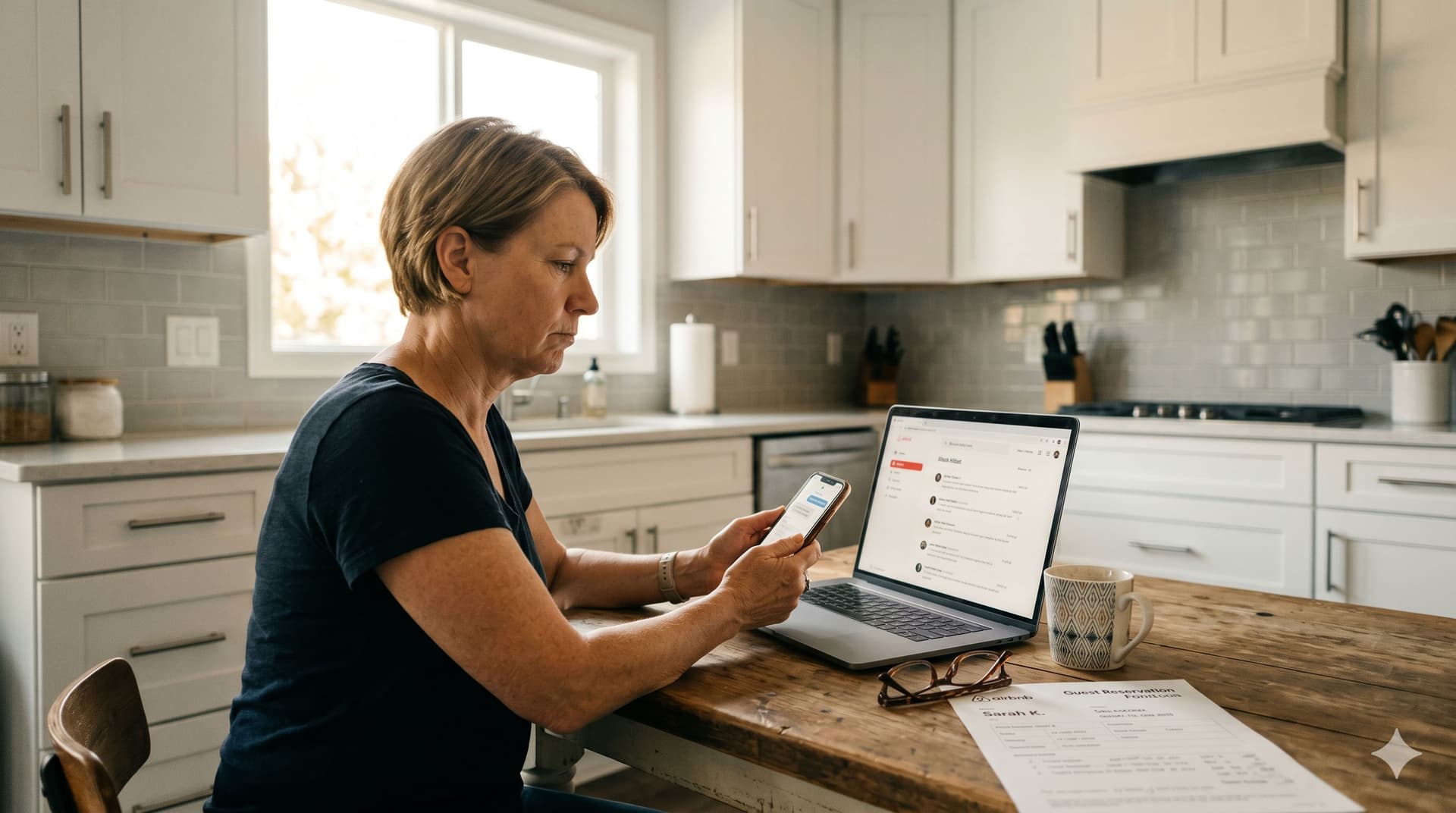
Airbnb scams by guests are real, they're becoming more sophisticated, and every host will eventually encounter one. The most common scams don't involve stolen TVs or broken windows, they involve guests who manipulate Airbnb's refund policies, review system, and Resolution Center to get free or heavily discounted stays.
This guide covers the specific scam playbooks guests use, real scenarios from hosting communities on Reddit and the Airbnb Community Forum, and the practical steps you can take to protect yourself. If you've already been scammed, we'll cover how to fight back.
What Are the Most Common Airbnb Scams by Guests?
The most common Airbnb scams by guests are the cleanliness complaint refund hack, review extortion, fabricated damage claims, chargeback fraud, and the third-party booking scam. Each exploits a different part of Airbnb's platform, and each has a specific defense.
Scam 1: The cleanliness complaint refund hack
How it works: A guest checks in, stays their full reservation, and then files a cleanliness complaint through Airbnb, often submitting photos of mess they created themselves as "evidence" the property wasn't clean at check-in. Airbnb's Support team reviews the photos and frequently issues a 50–100% refund without verifying the host's side of the story.
One host on the Airbnb Community Forum described the pattern bluntly: guests now know that taking a photo of any mess and filing a cleanliness complaint is an easy path to a free stay. Another host on the AirHostsForum described having a 4.91 rating across 340+ reviews and still having a guest fabricate a cleanliness complaint to demand a refund, twice.
A variation: the pre-negotiation version. As one Reddit user described: "Guest asks for a cleaning fee discount. Doesn't get the discount, books anyway, then sends a litany of complaints, stains on sheets, mis-installed light fixtures, photos don't match, spiders, cobwebs. Wants… no surprise, the cleaning fee refunded."
How to defend yourself:
- Take timestamped photos of every room after your cleaner finishes and before the guest arrives, this is your proof the property was clean at check-in
- Respond immediately to any cleanliness complaints during the stay and offer to send your cleaner to address the issue, if the guest refuses your offer to fix the problem, it undermines their claim
- Keep all communication on the Airbnb platform, your message history is what Support reviews
Scam 2: Review extortion
How it works: A guest threatens to leave a negative review unless you provide a discount, refund, or special accommodation. This can happen during the stay ("The Wi-Fi is slow, I expect a partial refund or I'll mention it in my review") or after checkout ("I wasn't satisfied with [minor issue], I think a partial refund is fair, otherwise I'll have to rate my experience honestly").
How to defend yourself:
- Do not give in. Review extortion is a direct violation of Airbnb's Content Policy. The moment a guest ties their review to a financial demand, report it.
- Screenshot or note the exact message (it should be in your Airbnb message thread) and contact Airbnb Support with the extortion claim
- Airbnb can remove reviews that violate their extortion policy, but only if you have the evidence on-platform
- If the guest does leave a retaliatory review, you can respond publicly (future guests read your response) and request removal through Airbnb's dispute process
Scam 3: Fabricated damage or pest claims
How it works: A guest brings evidence of a problem that doesn't exist, then photographs it as if they discovered it at your property. The most memorable example from hosting communities: a guest who brought a pet white mouse to the property (captured on a Ring doorbell camera in a clear carrier), released it inside, photographed it running around, and filed a pest complaint demanding a full refund.
Other variations include guests who claim appliances are broken (after unplugging or tampering with them), report pre-existing damage as new, or stage photos of messes they created.
How to defend yourself:
- Before-and-after photo documentation (again, the universal defense)
- Smart home devices (doorbell cameras, noise monitors) can capture evidence of what guests bring into the property, within Airbnb's monitoring policy
- Respond to every complaint immediately and offer to send someone to inspect or fix the issue, a guest who refuses your help is harder to take seriously in a dispute
- For pest claims specifically: if you have a regular pest control service, their dated inspection reports prove the property was pest-free before the guest's stay
Scam 4: Chargeback fraud
How it works: A guest completes their entire stay, appears satisfied, and then contacts their credit card company to dispute the Airbnb charge, claiming it was fraudulent or that the service wasn't delivered as described. This is sometimes called "friendly fraud" and it's extremely difficult to fight because the dispute happens outside of Airbnb's system.
How to defend yourself:
- Keep all communication on-platform, this creates the paper trail Airbnb needs to challenge the chargeback on your behalf
- A guest with positive messages throughout their stay and no complaints has a weak chargeback case
- If Airbnb contacts you about a chargeback, respond immediately with all documentation (booking confirmation, messages, photos)
- Consider requiring a signed rental agreement for higher-value bookings, this is additional evidence if the dispute goes to arbitration
Scam 5: Third-party bookings
How it works: Someone books your property on behalf of someone else, the person who shows up isn't the person whose name is on the reservation. This violates Airbnb's terms of service and creates a liability gap: the actual guest hasn't agreed to your house rules, hasn't been screened by Airbnb, and may not be covered by AirCover if something goes wrong.
How to defend yourself:
- If a guest messages asking to book for a friend or family member, politely decline and ask the actual guest to create their own profile and book directly
- If you discover a third-party guest after check-in, contact Airbnb Support, they can assist with cancellation if needed
- For Instant Book listings, consider requiring verified ID and a minimum number of previous reviews
How Do You Protect Yourself Against Airbnb Guest Scams?
You protect yourself against Airbnb guest scams through four defensive layers: photo documentation, on-platform communication, prompt response to complaints, and guest screening. No single defense is foolproof, but together they make you a very difficult target.
Layer 1: Photo documentation (the universal defense)
We've said it three times already because it's that important. Timestamped photos of your property, taken by your cleaner after every turnover, before the next guest arrives, are the evidence that wins or loses every type of dispute.
The routine takes 5 minutes per turnover:
- Wide shot of each room
- Close-ups of high-value or high-risk items (appliances, countertops, upholstery, electronics)
- Bathroom fixtures and surfaces
- Any existing wear or damage you're aware of (document it proactively so a guest can't claim it as new)
Store photos organized by date and booking. Your cleaner should send them to you or to a shared album after every clean.
The critical dependency: This documentation routine only works if your cleaner arrives on time after every checkout. If they're late, or don't know about the turnover at all, you have no pre-arrival photos for that booking, and your next dispute is unwinnable.
GleamSync ensures your cleaner always knows about every turnover by syncing with your Airbnb and VRBO calendars and sending automated notifications with the exact checkout time, check-in time, and property address. When bookings change, cancellations, extensions, new same-day bookings, the notification updates automatically. Your documentation window stays open because your cleaner always arrives on schedule.
Layer 2: On-platform communication only
Never discuss disputes, damage, refunds, or complaints off the Airbnb platform. No texts, no phone calls, no WhatsApp, no email. Airbnb Support reviews your on-platform message history to make their determination, off-platform conversations don't exist in their system.
This also means: if a guest calls you to complain, follow up with an Airbnb message summarizing the call. "Hi [guest], following up on our phone call, you mentioned [issue]. this is what we're doing to address it." Now it's on the record.
Layer 3: Prompt response to every complaint
When a guest complains about anything, cleanliness, a broken item, noise, temperature, respond immediately and offer a specific solution. "I'm sorry about that. I can have my cleaner there in 30 minutes to address it" or "I'll send my handyman over this afternoon."
This does two things: it often solves the actual problem (many complaints are legitimate), and it creates a record showing you were responsive and attempted to resolve the issue. A guest who refuses your offer to fix the problem and later demands a refund has a much weaker case with Airbnb Support.
Layer 4: Guest screening
Not every scam is preventable through documentation, some require not accepting the booking in the first place.
Red flags to watch for:
- New profile with no reviews, no photo, and minimal information
- Guest who asks to book for someone else (third-party booking)
- Guest who immediately asks for a discount before or after booking
- Guest who wants to communicate off-platform (asks for your phone number or email before checking in)
- Last-minute booking for a large property with vague responses about the purpose of the trip
None of these are automatic declines, but they're worth a closer look and potentially a conversation before accepting.
What Should You Do If You've Already Been Scammed?
If you've already been scammed, the guest got a refund you believe was fraudulent, or you're dealing with a retaliatory review, you still have options.
For fraudulent refund claims
- Respond to Airbnb's case within 24 hours - if Airbnb has issued a refund, you can appeal by providing your evidence (before photos, communication records, cleaning records)
- Escalate beyond the first agent - if the initial resolution doesn't go your way, request that the case be reviewed by a supervisor or specialist team. Be persistent, polite, and document every interaction.
- Leave an honest review of the guest - future hosts deserve to know. Keep it factual: "Guest filed a cleanliness complaint after their stay despite the property being professionally cleaned. Would not host again."
- Report the guest - if you believe the behavior was deliberately fraudulent, report it through Airbnb's Trust & Safety channel. Patterns of behavior across multiple hosts can lead to guest account removal.
For retaliatory reviews
- Respond publicly - Airbnb allows you to post a public response to any review. Keep it professional and factual: "This guest filed a refund request that was not supported by our documentation. We maintain thorough cleaning records and before/after photo documentation for every stay." Future guests read your response, your tone matters more than the original review.
- Request removal - if the review was left in retaliation for a damage claim or is factually false, submit a removal request citing Airbnb's Content Policy. Include the on-platform message thread showing the timeline.
- Don't let it derail you - one bad review among 30+ good ones doesn't significantly impact your rating or bookings. Respond, report if warranted, and move on.
For a detailed guide on the review removal process, see our article on how to get an unfair Airbnb review removed.
Frequently Asked Questions
Are Airbnb scams by guests really that common?
They're not the majority of bookings, most guests are honest and respectful. But experienced hosts in online communities consistently report encountering at least one scam attempt per year. The "cleanliness complaint" refund tactic appears to be the most common, likely because it requires the least effort from the guest and Airbnb's resolution process tends to favor guest-submitted photo evidence. The risk increases with higher booking volume and during peak seasons when last-minute bookings are more frequent.
Can Airbnb detect when a guest is running a scam?
Airbnb has some automated screening (identity verification, pattern detection), but hosts consistently report that the Resolution Center process relies heavily on the evidence each side provides rather than proactive fraud detection. If a guest has a history of filing refund complaints across multiple hosts, that pattern may eventually trigger an account review, but it's not instant, and it depends on hosts reporting the behavior.
What should I do if a guest threatens me with a bad review?
Report it to Airbnb immediately through the platform. Review extortion is a specific policy violation. Do not give the guest what they're asking for, capitulating rewards the behavior and doesn't prevent the review. Keep the threatening message in your Airbnb message thread (don't delete it) and reference it in your report to Support. If the guest follows through on the threat, request review removal on the grounds of extortion.
Should I get a security camera for my Airbnb?
Airbnb's updated monitoring policy (effective April 2024) prohibits all security cameras inside the property and requires disclosure of any exterior cameras. Doorbell cameras (Ring, Nest) positioned at the front entrance are generally compliant and provide valuable evidence for third-party booking scams, unauthorized party situations, and fabricated claims about what guests brought into the property. Always disclose any exterior monitoring devices in your listing.
How do I prevent chargeback fraud?
Keep all communication on the Airbnb platform, ensure the guest's booking confirmation and your messages show a completed, undisputed stay, and respond immediately if Airbnb contacts you about a chargeback. Beyond that, chargeback disputes happen between the guest and their credit card company. Airbnb handles the defense on your behalf using the on-platform records. Your job is to make sure those records are clean and complete.
The Best Defense Against Scams Is a Property That's Always Guest-Ready
Fake cleanliness complaints are the #1 guest scam, and the only defense is proof that your property was clean when the guest arrived. That proof comes from your cleaner's before-arrival photos, taken at every turnover, on time, without exception.
GleamSync connects to your Airbnb and VRBO calendars, detects every turnover window automatically, and sends your cleaner exactly what they need to know, exactly when they need to know it. When your cleaner always arrives on schedule, your documentation never has gaps.
Try GleamSync for $8/month per property, and keep the cleaner who already knows your place.
Start your free trial at gleamsync.com
Related reading:
Share this article

Mark Fromson
Founder of GleamSync and vacation rental owner. Learn more
Related Articles
Airbnb Deep Clean vs. Turnover Clean: When to Do Each
Airbnb deep clean vs turnover clean: what each includes, how often to schedule them, cost comparisons, and how to coordinate both with your cleaner.
How to Become an Airbnb Superhost: The Operational Playbook
A practical guide to earning and keeping Airbnb Superhost status. Covers all four requirements and the operational systems that keep you qualified.
Vacation Rental Maintenance Checklist: A Seasonal Guide
A seasonal vacation rental maintenance checklist for Airbnb and VRBO hosts. Monthly, quarterly, and annual tasks for HVAC, plumbing, safety, and appliances.
Simplify Your Cleaning Coordination
Sync Airbnb, VRBO, Booking.com or any calendar with a link, notify your cleaners automatically, and never miss a turnover.
Start Free Trial