
How to Get an Unfair Airbnb Review Removed
How to get an unfair Airbnb review removed. What qualifies, how to file a dispute, and how to respond to reviews you cannot get taken down.
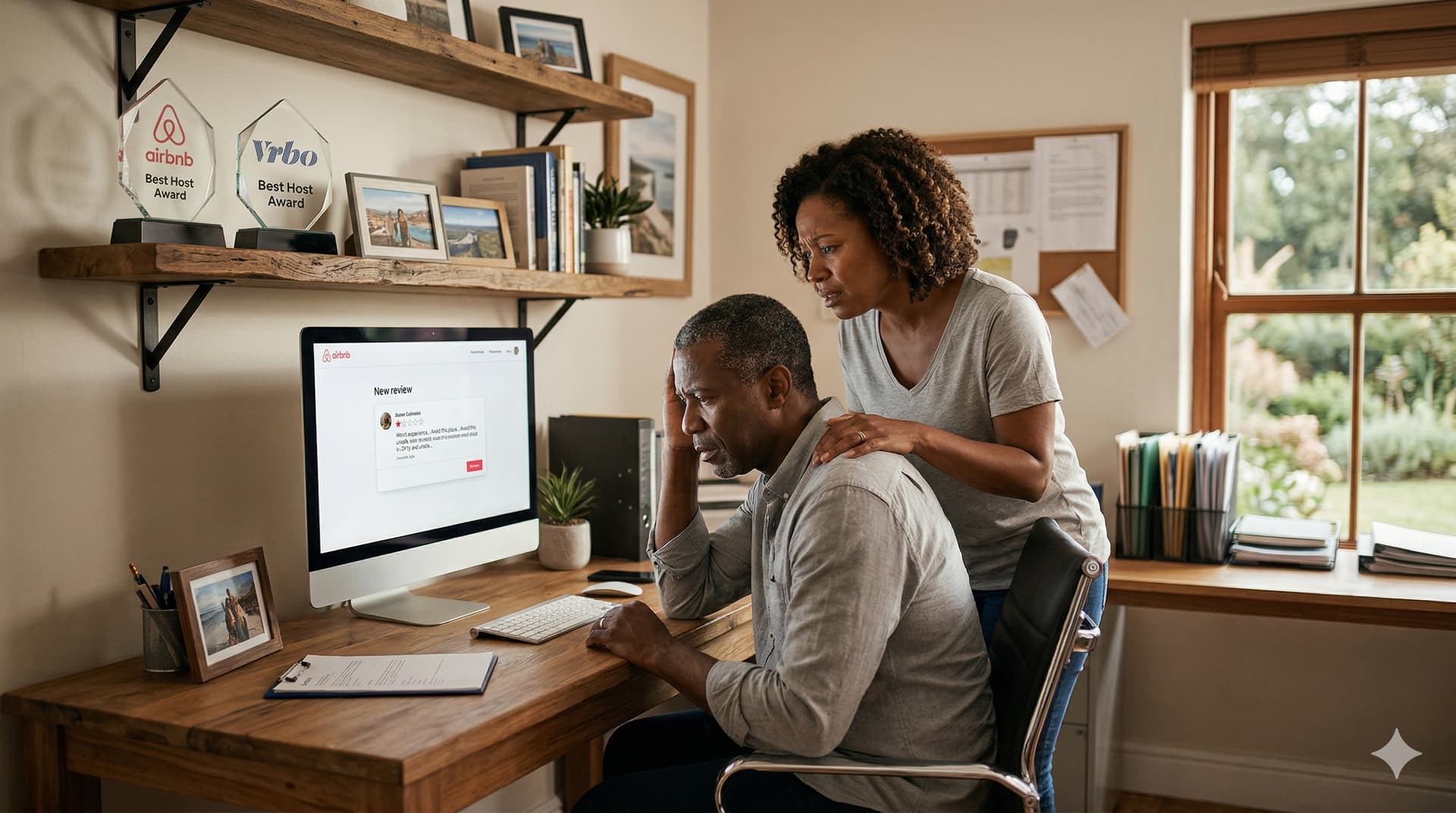
Getting an unfair review on Airbnb is one of the most frustrating experiences in hosting. You maintain a spotless property, respond to every message within minutes, and go out of your way to make guests comfortable, and then one guest leaves a 2-star review over something that wasn't your fault, was exaggerated, or never happened.
The bad news: most unfair reviews can't be removed. Airbnb's platform is built on the premise that reviews represent authentic guest experiences, and the bar for removal is deliberately high.
The good news: you have more options than you think. This guide walks you through exactly what qualifies for removal, how to file a dispute, how to craft a public response when removal isn't possible, and how to prevent the most common cause of unfair reviews, retaliation after damage claims.
What Types of Reviews Can Airbnb Remove?
Airbnb can remove reviews that violate their Content Policy. Subjective opinions, even harsh, unfair, or one-sided ones, generally don't qualify. The specific grounds for removal are narrow and clearly defined.
Reviews Airbnb will consider removing
1. Retaliatory reviews
A review left in retaliation for a host enforcing house rules, filing a damage claim, or reporting a safety concern. The key word is "retaliation", you need to show a clear connection between your action (e.g., filing a Resolution Center claim) and the guest's negative review.
This is the most common basis for removal requests in hosting communities. As one host on the Airbnb Community Forum described: they filed a damage claim for broken furniture and pet damage in a no-pet property, and the guest, who had been pleasant during the stay, immediately left a 1-star review making claims that contradicted their earlier messages.
Evidence that helps: On-platform messages showing the guest was satisfied during their stay, followed by a negative review only after you filed a claim or enforced a rule.
2. Extortion-linked reviews
A review from a guest who previously threatened to leave a bad review unless you provided a discount or refund. Airbnb's Content Policy specifically prohibits using reviews as leverage.
Evidence that helps: On-platform messages containing the threat. This is why you must keep all dispute communication on the Airbnb messaging system, off-platform threats can't be verified.
3. Reviews with irrelevant content
Reviews that discuss things outside the host's control or unrelated to the stay, political commentary, complaints about Airbnb's platform fees, personal attacks unrelated to the property, or experiences that happened off-property.
4. Reviews containing discriminatory content
Any review that includes discrimination based on race, ethnicity, religion, gender, sexual orientation, disability, or other protected characteristics.
5. Reviews from guests who didn't stay
If a guest cancels their reservation but somehow leaves a review (a rare platform glitch), or if you can prove the person who reviewed wasn't the person who stayed (third-party booking situation).
Reviews Airbnb will NOT remove
- A review you simply disagree with ("The bed was uncomfortable", even if you have a $3,000 mattress)
- A review with subjective opinions ("The neighborhood was noisy", even if it's usually quiet)
- A low star rating without specific policy violations in the text
- A review from a guest who had a genuinely bad experience, even if you believe you did everything right
- A review that's harsh or unfair but doesn't violate any specific Content Policy provision
This distinction frustrates hosts endlessly. A guest can leave a 1-star review saying "the sheets felt scratchy" and Airbnb won't remove it, because it's a subjective experience, even if you provide hotel-quality linens. Understanding this limitation upfront saves you time and emotional energy.
How Do You Request a Review Removal?
You request a review removal by contacting Airbnb Support and citing the specific Content Policy violation. The process takes 3–10 business days and requires evidence.
Step-by-step process
-
Identify the specific violation - before contacting Airbnb, determine which Content Policy provision the review violates (retaliation, extortion, irrelevant content, discrimination). If you can't name a specific violation, your request will likely be denied.
-
Gather your evidence - collect the on-platform message thread showing the timeline: positive messages during the stay, the incident that triggered the review (damage claim, rule enforcement), and the review itself. Screenshots help, but Airbnb can see the messages directly.
-
Contact Airbnb Support - you can reach them through the Help Center, live chat, or by calling. Reference the specific review by guest name and booking dates. State the Content Policy violation clearly: "I'm requesting removal of this review on the basis of [retaliation/extortion/etc.]."
-
Provide your evidence - Airbnb will ask for documentation. Share the message timeline, any photos, and your explanation of why the review violates the policy.
-
Wait for the decision - Airbnb's team reviews both sides. They may contact the guest. The process typically takes 3–10 business days. You'll receive a response by email.
-
Appeal if denied - if your initial request is denied, you can request a second review by a different team member. Be specific about what you think the first reviewer missed. Some hosts report success on appeal after being denied initially.
Tips from hosts who've succeeded
- Be concise and factual, don't write an emotional essay. State the violation, provide the evidence, and make a clear ask.
- Reference the specific Content Policy provision by name: "This review violates your Retaliation section" is stronger than "this review is unfair."
- Show the timeline clearly: "Guest messages on March 5 saying 'Great stay, thank you!' → I filed damage claim on March 6 → Guest left 1-star review on March 7" makes the retaliation pattern obvious.
- Be persistent but polite, some hosts report getting different responses from different agents. If you genuinely believe the review violates policy, try again with fresh evidence presentation.
How Do You Respond to a Review You Can't Get Removed?
When a review can't be removed, which is the majority of cases, your public response becomes your primary tool. Future guests read your response just as carefully as the review itself, and a professional, measured reply often does more for your credibility than the negative review damages it.
The anatomy of a good public response
Do:
- Acknowledge the guest's experience briefly ("We're sorry this guest's stay didn't meet their expectations")
- Provide factual context without being defensive ("Our property is professionally cleaned before every stay, with timestamped photos documenting the condition")
- Mention any steps you took to address the issue during the stay ("We offered to send our cleaner immediately when the guest raised this concern")
- Keep it under 3–4 sentences, brevity signals confidence
Don't:
- Attack the guest personally
- Get drawn into a point-by-point rebuttal of every claim
- Mention the damage claim, refund dispute, or financial details
- Use sarcastic, passive-aggressive, or emotional language
- Write a wall of text, it looks defensive
Response templates for common situations
For a retaliatory review after a damage claim:
"We value all guest feedback. This review was posted after we filed a claim for damage discovered during our post-stay inspection. Our property is professionally cleaned and documented with timestamped photos before every guest's arrival. We maintain thorough records and welcome any prospective guest to ask about our property care standards."
For an exaggerated cleanliness complaint:
"We take cleanliness seriously, our property is professionally cleaned before every stay by the same dedicated cleaner who knows the property inside and out. We offered to address any concerns during this guest's stay. We're sorry their experience didn't match the standard our 50+ five-star reviews reflect."
For a vague low-star review with no specifics:
"We're sorry this guest's experience fell short. We strive for five-star stays and welcome any specific feedback that helps us improve. Our property has [X] five-star reviews and we're committed to maintaining that standard."
How Do You Prevent Unfair Reviews?
You prevent unfair reviews through proactive guest communication, strategic review timing, consistent documentation, and by avoiding the situations that most commonly trigger retaliatory reviews.
The day-14 review strategy
Both hosts and guests have 14 days after checkout to leave a review. Reviews are hidden until both parties have submitted (or the 14-day window closes). This creates a strategic opportunity.
Many experienced hosts wait until day 13 or 14 to submit their review for problematic guests. The reasoning: if you submit your review early and the guest sees the notification, they know something is coming and may preemptively leave a negative review. By waiting until the last day, you reduce the window for retaliation.
This doesn't prevent all retaliatory reviews, some guests leave their review right after checkout regardless. But it limits the damage in the common scenario where a guest wouldn't have bothered reviewing at all if they hadn't seen your review notification first.
Proactive mid-stay check-ins
Send a brief message mid-stay: "Hi [guest], just checking in, is everything going well? Let us know if there's anything we can help with." This does three things: it catches real problems you can fix before checkout, it demonstrates responsiveness (which helps in any dispute), and it creates a message record showing the guest had an opportunity to raise concerns during their stay.
If a guest responds with "Everything's great, thank you!" and then leaves a 2-star review, that message weakens their credibility.
Documentation as prevention
This connects back to every other article in this series: your cleaner's before-and-after photos, taken at every turnover, are the evidence that makes damage claims winnable and weakens fabricated complaints. When your documentation is airtight, you can file claims with confidence knowing that even if the guest retaliates with a review, you have the evidence to request removal.
And that documentation only happens when your cleaner knows about every turnover. GleamSync automates that notification, ensuring your cleaner arrives on time and your documentation routine never has gaps.
Frequently Asked Questions
How long does the Airbnb review removal process take?
Typically 3–10 business days from when you submit the request with evidence. Complex cases, especially those involving retaliation claims where Airbnb needs to contact the guest, can take longer. If you haven't heard back in 10 days, follow up through Support.
Can Airbnb remove a review without the guest's consent?
Yes. If the review violates Airbnb's Content Policy, they can and do remove it unilaterally. The guest is typically notified that their review was removed, but their consent isn't required.
What happens to my rating if a review is removed?
The star rating associated with the removed review is also deleted from your average. If a 1-star retaliatory review was pulling your overall rating down, removing it will immediately improve your average.
Can I edit or delete my own review of a guest?
You can edit your review of a guest within 48 hours of submitting it. After that, you can only contact Airbnb Support to request a change, which they'll generally only do in rare circumstances. You cannot delete your own review once the 48-hour edit window has passed.
Should I respond to every negative review?
Yes, even if the review is minor. A brief, professional response shows future guests that you're attentive and care about the experience. For clearly unfair reviews, your response is the only thing between you and a prospective guest's impression. For mildly negative reviews with valid points, acknowledging the feedback and explaining what you've done about it is powerful: "Thank you for this feedback. We've since replaced the mattress and upgraded our linens based on guest suggestions."
The Best Defense Against Bad Reviews Is a Property That's Always Guest-Ready
Most retaliatory reviews start with a cleaning-related dispute. A cleaner who arrives on time, follows a consistent checklist, and documents the property before every guest arrival gives you the evidence to handle disputes from a position of strength, whether that means winning the claim, getting the review removed, or simply posting a confident public response.
GleamSync connects to your Airbnb and VRBO calendars, detects every turnover window automatically, and sends your cleaner exactly what they need to know, exactly when they need to know it.
Try GleamSync for $8/month per property, and keep the cleaner who already knows your place.
Start your free trial at gleamsync.com
Related reading:
Share this article

Mark Fromson
Founder of GleamSync and vacation rental owner. Learn more
Related Articles
Airbnb Deep Clean vs. Turnover Clean: When to Do Each
Airbnb deep clean vs turnover clean: what each includes, how often to schedule them, cost comparisons, and how to coordinate both with your cleaner.
How to Become an Airbnb Superhost: The Operational Playbook
A practical guide to earning and keeping Airbnb Superhost status. Covers all four requirements and the operational systems that keep you qualified.
Vacation Rental Maintenance Checklist: A Seasonal Guide
A seasonal vacation rental maintenance checklist for Airbnb and VRBO hosts. Monthly, quarterly, and annual tasks for HVAC, plumbing, safety, and appliances.
Simplify Your Cleaning Coordination
Sync Airbnb, VRBO, Booking.com or any calendar with a link, notify your cleaners automatically, and never miss a turnover.
Start Free Trial