
Airbnb cleaning contract template for cleaners
A free Airbnb cleaning contract template for cleaners, from a host who pays one. The clauses hosts sign, plus late cancellations, booking changes and payment.
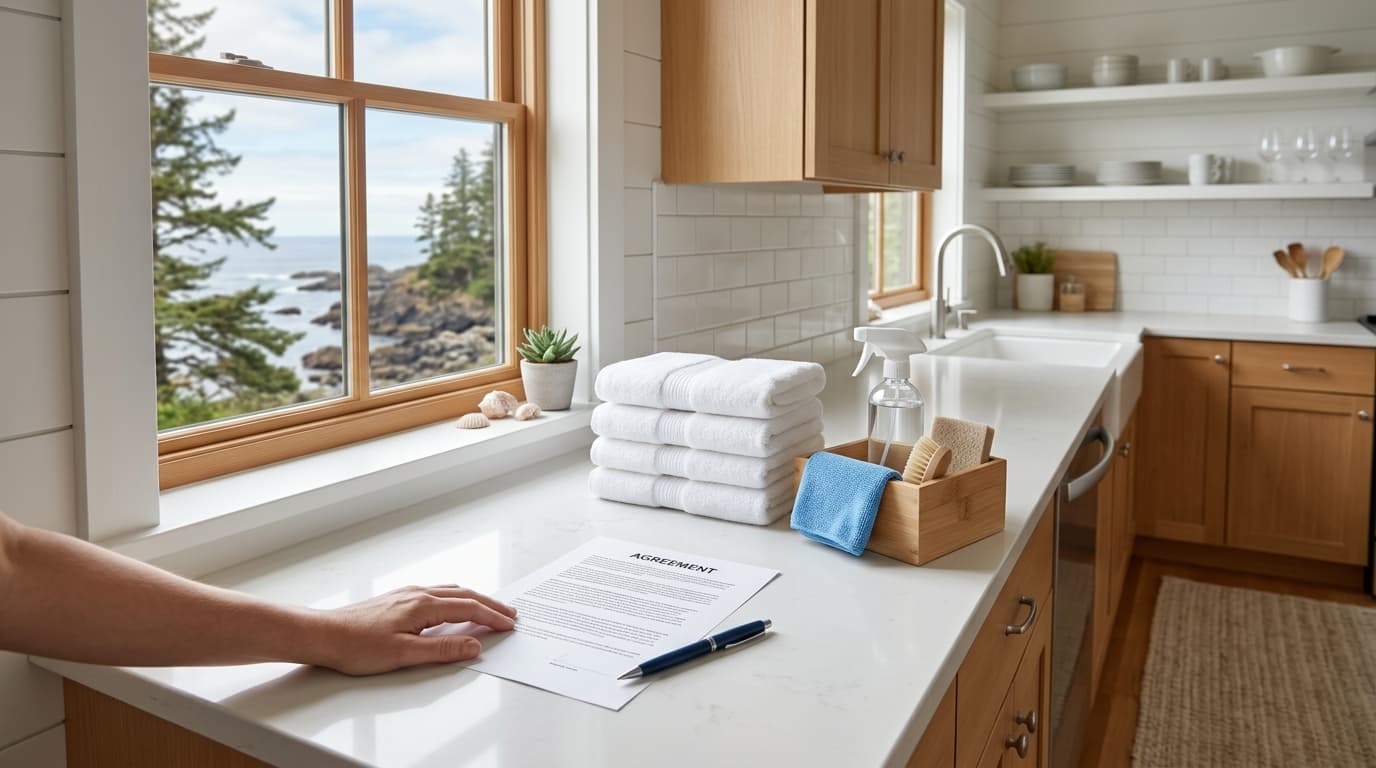
Most Airbnb cleaners work on a handshake and a text thread. That works until a guest cancels the night before, a booking moves and nobody tells you, or an invoice sits unpaid for weeks. A simple Airbnb cleaning contract, built from a template like the one below, settles those questions before they turn into an argument with a host you want to keep.
I'm a host, not a cleaner. I own a vacation rental in Ucluelet, BC, and I pay a cleaner to turn it over between guests. What she and I have in writing is a price list, and it does more of the work of a contract than anything else we've agreed.
The free templates that rank for this search are written for hosts and property managers, as the side doing the hiring. This one is written for you, the cleaner, setting out your own terms. It covers what hosts look for before they say yes, and the gaps those other templates leave open, like late cancellations, booking changes and when you get paid. There's a fill-in template near the end.
What is an Airbnb cleaning contract?
An Airbnb cleaning contract, also called a short-term rental (STR) cleaning agreement, is a short written agreement between a cleaner and a host. It says which properties you clean, what a standard turnover includes, what each clean costs, what counts as an extra, and how and when you get paid.
It doesn't need to be long or formal. A one-page document that both of you have read and agreed to by email is far better than nothing. The point is that when something unusual happens, you both look at the same page instead of remembering different conversations.
What should an Airbnb cleaning contract include?
These are the clauses worth having. The ones hosts care about most are near the top.
- The properties and the job. Which addresses, and what a standard turnover covers.
- Your price list. A base rate per clean, plus a fixed charge for each extra.
- Payment. How you invoice, and how soon the host pays.
- Booking changes and cancellations. How the host tells you about changes, and what you're paid if a clean is cancelled late.
- Cover when you can't make it. How you'll tell the host, who finds a replacement, and how much notice counts as last minute.
- Supplies. Who buys what, and how you get paid back.
- Access. How you get in, and who to call if you can't.
- Damage and missing items. What you report, how, and how fast.
- Ending the agreement. How much notice either of you gives.
- Contractor status. A plain statement that you're running your own business.
If you only write down one of these, make it the price list.
Why is the price list the most important part?
Because it's the part a host uses every week. When your invoice arrives, the host should be able to check it against your price list in a few seconds and pay it. When the invoice has a line the host doesn't recognise, payment slows down while they ask you about it.
The price list my cleaner and I agreed in writing is short. The amounts are between her and me, but the structure is worth copying:
- Standard multi-day clean: the base rate
- Same-day turnover: added on top of the base rate
- Larger groups: an add-on when more guests stay than the property normally sleeps, because a fuller house means more use and more cleaning time
- Extra bed: charged per bed
- Pet clean: a fixed add-on
- Restock or propane errand: a fixed add-on
- BBQ clean: a fixed add-on
A few things make this work from my side. Every extra has a fixed price, so neither of us has to negotiate after the fact. Most of the extras are things I can see in the booking, like the number of guests, a pet or a same-day turnover, so I can check an invoice against it. And it pays her more for the jobs that take more work. A same-day turnover is harder on her, so it costs more.
Your numbers will be different. They depend on your local rates, the size of the properties and how long a clean takes you. Our guide to pricing your Airbnb cleaning services walks through how to set them. The structure is what to copy: one base rate, then a short list of extras, each with its own price.
When should a host pay you?
Put a payment window in writing. "Payment within a few days of the invoice" is something both of you can hold to. "Payment soon" isn't.
I usually pay my cleaner within a day of getting her invoice. When I'm away on vacation, I tell her ahead of time that payment will be slower, so she isn't left wondering. That's the habit to ask for in a contract: a normal payment window, and a heads-up from the host when it's going to slip.
Your contract should also say how you'll invoice (email is fine), how the host pays you, and what happens if a payment is late. You don't need penalties to start with. A clear due date does most of the work.
How should a cleaning contract handle cancellations and booking changes?
The popular free templates for this search don't include a clause for late cancellations, so this part is up to you.
To be honest about my own setup: my cleaner and I don't have a cancellation clause. It has never come up. But bookings at my place do move. Before I used GleamSync, I coordinated cleans with a shared spreadsheet, and forgetting to update it after a booking change led to a missed clean. If you clean for several hosts, cancellations and changes will come up sooner or later.
There are two separate things to agree.
What you're paid for a late cancellation. Pick a cut-off that suits you, such as the day before the clean. If the host cancels a clean after the cut-off, you're paid a set fee or part of your base rate. If they cancel before it, you're not. Some cleaners don't charge for this at all, and that's a fair choice too, as long as it's a choice you've written down rather than a surprise.
How you'll hear about changes. A booking that moves a day earlier and never reaches you is how a guest arrives to a property that hasn't been cleaned. Agree in writing that the host will tell you about every date change and cancellation, how they'll tell you (text, email or WhatsApp), and that you'll confirm you've seen it.
Some hosts use a tool for this part. GleamSync, a vacation rental cleaning coordination tool, reads the host's Airbnb and Vrbo calendars and works out the cleaning window between each checkout and the next check-in. Once the host assigns you a clean, GleamSync sends you date changes and cancellations for cleans within the next month by email, text (U.S. and Canada) or WhatsApp. Email and text messages include the new cleaning window. It never assigns a cleaner automatically, so the host still chooses who gets each clean.
What if you can't make a clean?
Your contract should cover this too, because it's the clause a host cares about most. A clean that doesn't happen means a guest walks into a property nobody has turned over.
Who finds the replacement varies. Some cleaners have helpers they can send. Some hosts keep a backup cleaner of their own and would rather call them. Neither is wrong, so your contract should say which applies to you.
What doesn't vary is that you're part of the solution. As a host, the minimum I'd expect is that you tell me the moment you know you can't make it, and work with me to find someone who can. If you're sending a replacement, they should be someone I've already agreed to, so I'm not handing access to a stranger, and I should know who's coming before the clean.
"Last minute" needs a definition, or it means whatever suits whoever is speaking. The simplest approach is to use the same cut-off as your cancellation clause, such as the day before the clean. Pick one that suits your area and how quickly a replacement can get there. The closer to the clean you cancel, the more it matters that you stay on the phone with your host until someone is booked.
Who pays for cleaning supplies?
Write it down, because "who's buying the cleaning spray?" turns into an argument surprisingly fast.
At my place, I buy most of the cleaning supplies, and my cleaner brings some of her own equipment. For the things she picks up herself, we use a kitty. I give her a float to spend on supplies, she sends me her receipts, and we track what's been spent. When the kitty runs low, I top it back up. When she makes a special trip for a restock or propane, that's a separate line on the price list.
A kitty only works if both of you track it, but it saves her from paying out of pocket and waiting to be paid back. If a host prefers to buy everything themselves, your contract should say so, along with what you'll do when something runs out mid-clean.
How do you get in, and what if you can't?
Your contract should say how you get into each property and who to call if that fails. My cleaner has her own code for the smart lock, so getting in doesn't depend on me being reachable.
If the code doesn't work or the key isn't where it should be, you lose time you may not have on a same-day turnover. One line in the contract covers it: who you call, and what happens to your fee if you can't get in through no fault of your own.
What should you do about damage or missing items?
Agree what you report and how. Photos, sent to the host by text the same day, is a reasonable standard to write in. Hosts need clear evidence quickly if they're going to file a damage claim, and you're often the first person to see the problem. Our guide to Airbnb guest damage claims explains what hosts need.
Make it clear in writing that reporting damage doesn't make you responsible for it. You're the witness, not the cause.
What about ending the agreement and contractor status?
Add a notice period that works both ways, so neither of you is left without a cleaner, or without income, overnight.
Add a line saying you're an independent business providing a cleaning service, not the host's employee. Whether that statement holds up depends on where you live and how you actually work, and the rules on contractor status, tax and insurance vary by country, state and province. This article isn't legal advice. If you're relying on a contract for a lot of your income, have someone qualified in your area look it over.
Free Airbnb cleaning contract template
Download the editable template (Word) → It opens in Word, Google Docs or Apple Pages, with every part you need to fill in highlighted.
Or copy the version below into a document. Fill in the brackets and delete anything that doesn't apply. Then send it to your host and agree it by email if neither of you wants to sign anything.
Airbnb and STR cleaning services agreement
1. Parties. This agreement is between [your name or business name] ("the Cleaner") and [host's name] ("the Host").
2. Properties. The Cleaner will clean the following properties: [addresses].
3. Standard clean. A standard turnover includes [bedrooms, bathrooms, kitchen, living areas, linens, restocking guest supplies, garbage and recycling]. The Cleaner will follow [the attached checklist / the Host's checklist].
4. Price list. A standard clean costs [amount]. Extras are charged as follows:
- Same-day turnover: [amount]
- Larger groups: [amount for each group size]
- Extra bed, per bed: [amount]
- Pet clean: [amount]
- Errands (restock, supplies): [amount]
- Other: [item and amount]
5. Payment. The Cleaner will invoice by [email] after each clean, listing the date, property, base price and each extra. The Host will pay within [number] days of the invoice by [payment method]. If payment will be late, the Host will tell the Cleaner in advance.
6. Booking changes. The Host will tell the Cleaner about every new clean, date change and cancellation by [text / email / WhatsApp / scheduling tool]. The Cleaner will confirm each change.
7. Late cancellations. If a clean is cancelled after [cut-off, such as the day before], the Host will pay [amount or share of the base rate]. Cancellations before the cut-off are free.
8. Cover when the Cleaner can't attend. If the Cleaner can't do a clean, the Cleaner will tell the Host as soon as they know. [The Cleaner will arrange a replacement from people the Host has approved / The Host will arrange a replacement, with the Cleaner's help / The Cleaner and the Host will work together to find a replacement.] Any replacement the Cleaner sends will be someone the Host has approved, and the Host will be told who is coming before the clean. Notice given less than [the same cut-off as clause 7] before the clean counts as last minute.
9. Supplies. [The Host provides all supplies / The Host provides a supply float of (amount), topped up when low, with receipts sent for every purchase / The Cleaner provides supplies, charged at cost.] The Cleaner provides [equipment].
10. Access. The Cleaner will enter using [smart lock code / lockbox / key]. If the Cleaner can't get in, they will contact [name and number]. If a clean can't go ahead because of an access problem the Cleaner didn't cause, the Host will pay [amount].
11. Damage and missing items. The Cleaner will photograph any damage or missing items and send the photos to the Host by [text] on the day of the clean. Reporting damage doesn't make the Cleaner responsible for it.
12. Independent business. The Cleaner provides this service as an independent business and is not the Host's employee. The Cleaner is responsible for their own [tax, insurance and helpers].
13. Ending the agreement. Either party can end this agreement with [number] days' written notice.
14. Signatures. [Names, signatures, date.]
Frequently asked questions
Do I need a contract to clean Airbnbs?
You don't legally need one in most places, but you'll want one once you work for more than one host. At a minimum, get your price list and payment terms agreed in writing by email. That alone prevents most disputes over invoices.
Is this Airbnb cleaning contract template legally binding?
A written agreement can be binding, but whether a particular contract holds up depends on where you work and how it's written. This template is a starting point and isn't legal advice. If a lot of your income depends on one contract, have it reviewed by someone qualified in your area.
Should I charge a host when a clean is cancelled?
That's your call, and a lot of cleaners don't. If you do, set a cut-off, such as the day before the clean, and a set fee for cancellations after it. Put it in writing before it happens, so the conversation is about the contract and not about whether the host is being fair.
What if a host doesn't want to sign a contract?
Send them your price list and payment terms by email and ask them to reply to confirm. Plenty of hosts are happy to agree terms that way, and a confirmed email gives you most of the protection of a signature.
Related reading
- How to price Airbnb cleaning services: a host's view
- How to get Airbnb cleaning clients: what hosts look for
- What should I pay my vacation rental cleaner?
- Airbnb guest damage: when to file a claim, when to let go
- Airbnb cleaning checklist: room by room
Hear about booking changes before they cost you a clean
A contract says you'll be told about booking changes. GleamSync is one way hosts keep that promise. Once your host assigns you a clean, you get date changes and cancellations for the month ahead by email, text or WhatsApp. Your host can also send you a link that puts the cleaning schedule in your phone's calendar. It's free for cleaners, and you don't need an account. Your host pays $8 a month per property.
Share this article

Mark Fromson
Founder of GleamSync and vacation rental owner. How these articles are written · Learn more
Get each clean's details before you get there
GleamSync sends you each clean's times, extras and pay from your hosts' calendars. Free for cleaners, with no account or app needed.
See how GleamSync helps cleaners