
Airbnb House Rules Template: Examples & Best Practices
Create clear Airbnb house rules with our free template and real examples. Covers quiet hours, smoking, pets, checkout, parking, and problem prevention.
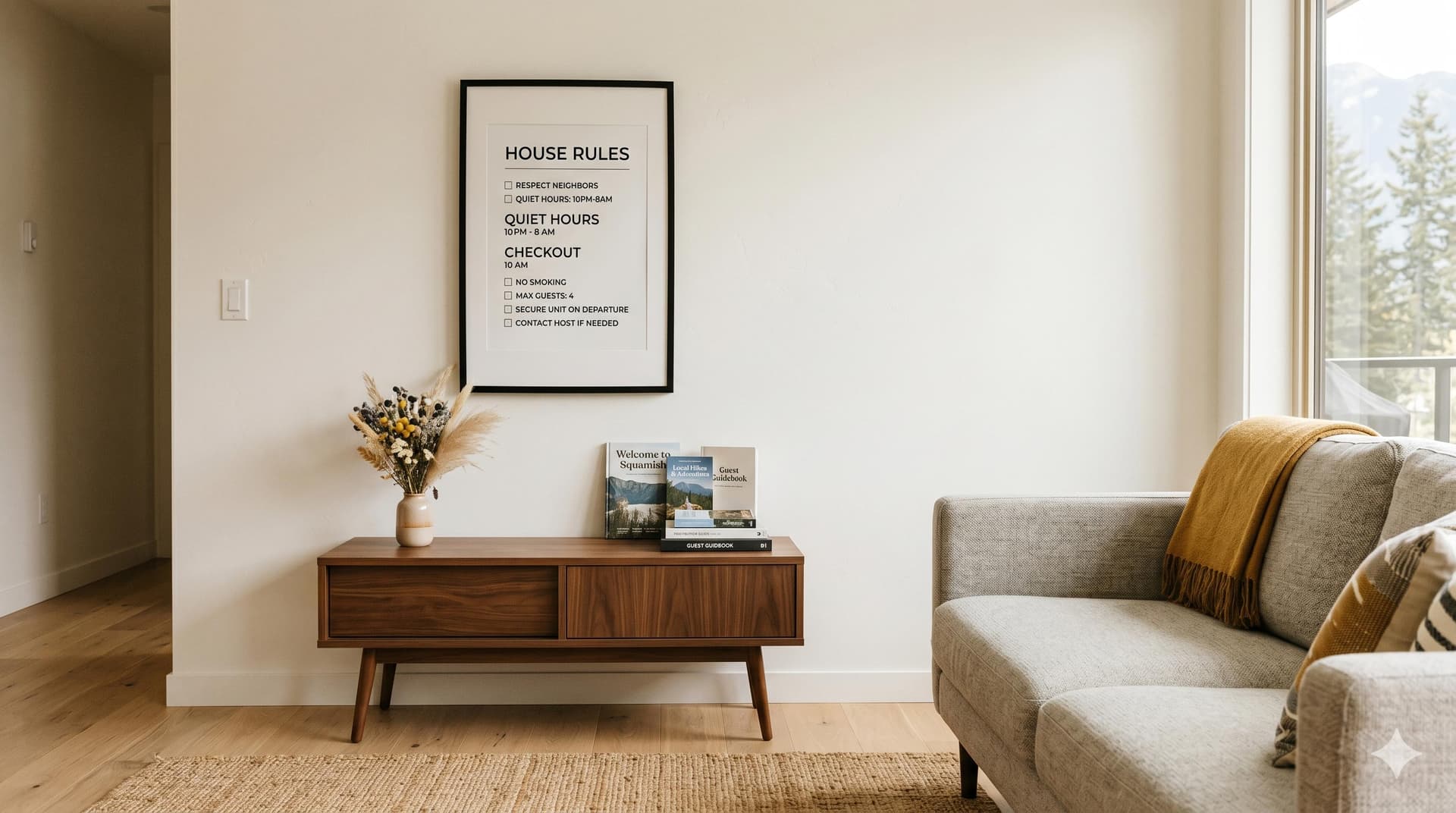
Airbnb house rules are the expectations and policies you set for guests staying at your property. They cover everything from quiet hours and smoking to checkout procedures and pet policies. Well-written house rules prevent problems before they happen by filtering out guests who won't follow them and setting clear expectations for guests who book.
This guide gives you a complete house rules template organized by category, with copy-paste examples you can adapt for your property. We'll cover what rules actually prevent the most issues (based on hosting community experience), what to avoid, and how to communicate rules so guests actually read them.
What House Rules Should Every Airbnb Have?
Every Airbnb should have rules covering these eight categories: quiet hours, smoking, pets, maximum occupancy, checkout procedures, parking, kitchen use, and property-specific safety rules. These are the categories where unclear or missing rules lead to the most host-guest conflicts.
Category 1: Quiet hours
Why it matters: Noise complaints from neighbors are one of the fastest paths to losing your short-term rental permit or HOA approval.
Template:
Quiet hours are 10:00 PM to 8:00 AM. Please keep music, conversation, and TV at a reasonable indoor volume during these hours. All outdoor gatherings must move inside by 10:00 PM.
Best practice: Specify exact times: "reasonable hours" means different things to different people. If your property has thin walls or nearby neighbors, tighten the window.
Category 2: Smoking
Template (no smoking):
This is a strictly non-smoking property, inside and outside. This includes cigarettes, e-cigarettes, vapes, and cannabis. Violation will result in a $250 deep cleaning charge billed through Airbnb's Resolution Center.
Template (outdoor smoking permitted):
Smoking is permitted outside only, in the designated area [describe location]. Please dispose of butts in the provided container. Indoor smoking of any kind is prohibited.
Best practice: Include e-cigarettes and cannabis explicitly, many guests assume "no smoking" means only tobacco. Stating a specific cleaning charge deters violations.
Category 3: Pets
Template (no pets):
No pets are permitted on the property. Service animals are welcome as required by law. If evidence of an undisclosed pet is found (hair, waste, odor), a $150 cleaning surcharge will apply.
Template (pets welcome):
Well-behaved dogs are welcome (maximum 2). A $30 per pet per stay fee applies. Pets must not be left unattended in the property. Please clean up after your pet in the yard before checkout.
Best practice: If you're pet-friendly, specify which animals, how many, and any restrictions. If you're pet-free, mention service animals to show you're aware of accessibility requirements.
Category 4: Maximum occupancy
Template:
Maximum occupancy is [X] guests, including children. The number of guests must match your booking. Visitors are welcome during daytime hours but may not stay overnight. Unauthorized additional overnight guests may result in booking cancellation.
Best practice: Be specific about whether children count (they do, for insurance and safety purposes). Define what a "visitor" vs. an "overnight guest" means.
Category 5: Events and parties
Template:
No parties or events are permitted. This property is for registered guests only. Unauthorized gatherings exceeding the booked guest count will result in immediate booking cancellation per Airbnb's Party Ban policy.
Best practice: Airbnb has maintained a permanent party ban since 2022. Reference it, it gives your rule institutional backing.
Category 6: Checkout procedures
Template:
Please check out by [TIME]. Before leaving:
- Gather used towels and leave them in the bathtub
- Bag trash and place it in the bin in the [garage / side of house]
- Turn off all lights, fans, and adjust the thermostat to [temperature]
- Lock the door. [smart lock auto-locks / return key to lockbox]
Best practice: Keep checkout tasks to 4–5 items maximum. Airbnb penalizes hosts for excessive checkout tasks. For a complete guide, see our Airbnb checkout instructions article.
Category 7: Parking
Template (designated parking):
Parking is available in the driveway for up to [X] vehicles. Please do not park on the grass or block the neighbor's access. Street parking is also available on [street name].
Template (no on-site parking):
There is no dedicated parking at this property. Street parking is available on [street name], please check posted signs for restrictions. The nearest parking garage is [name/address], approximately [X] minute walk.
Category 8: Kitchen use
Template:
The kitchen is fully equipped for guest use. Please wash dishes or load the dishwasher before checkout. Do not leave food in the refrigerator upon departure. Cooking oils and basic seasonings are provided, please do not remove them from the property.
Best practice: The most common kitchen complaint from cleaners is guests who leave food in the fridge. Make this explicit.
What House Rules Should You Avoid?
Avoid rules that are unenforceable, excessively controlling, or that make guests feel unwelcome. A long list of restrictive rules discourages bookings, experienced hosts keep their rules focused on the genuine issues.
Rules to skip:
- "No shoes in the house", unenforceable and annoys guests
- "Do not adjust the thermostat", guests will adjust it regardless; set it to reset automatically
- "No eating outside the dining area", creates a hotel-like, unwelcoming atmosphere
- "Strip all beds before checkout", this is your cleaner's job
- "Mop the kitchen floor", excessive checkout task that risks an Airbnb penalty
- "Do not rearrange furniture", unless it involves heavy items, this isn't worth a rule
- Anything passive-aggressive ("We WILL charge for any damage" as a first impression)
The general principle: if you need more than 15 rules, you may be managing risk through restrictions instead of through systems. Good guest screening, photo documentation, appropriate pricing, and clear communication prevent more problems than a 30-rule manifesto.
How Do You Communicate House Rules Effectively?
You communicate house rules through three channels: your Airbnb listing (guests see this before booking), your pre-arrival message (guests read this before check-in), and your in-property welcome book (guests reference this during their stay).
Channel 1: Airbnb listing
Airbnb's listing editor offers two types of house rules:
- Predefined toggles - smoking, pets, events, quiet hours, commercial photography. These display as icons on your listing page and appear in search filters. Always set these.
- Custom rules - free-text rules you write yourself. These appear in the "House rules" section that guests must acknowledge before booking.
Set every relevant predefined toggle AND add your custom rules. The predefined toggles are especially powerful because guests can filter by them, a guest searching for pet-friendly properties won't see your no-pet listing, which saves you from decline conversations.
Channel 2: Pre-arrival message
Include a brief summary of your most important rules in the automated message sent 1–2 days before check-in:
"Quick reminders: quiet hours are 10 PM–8 AM, the property is non-smoking (inside and outside), and checkout is by [time]. Full house rules and checkout details are in the welcome book on the kitchen counter."
Don't repeat all 12 rules, highlight the 3–4 that matter most and point them to the welcome book for the rest.
Channel 3: Welcome book / in-property
Your printed welcome book should include the full house rules in a dedicated section, clearly formatted with headings, not buried in a wall of text. Place it on the kitchen counter where guests will see it when they walk in.
Some hosts also post specific rules where they apply: a "Non-smoking property" sign near the patio door, quiet hours noted near the stereo or TV, and checkout instructions on the back of the front door.
Frequently Asked Questions
Can Airbnb enforce my house rules?
Airbnb can act on house rule violations, particularly for their predefined rules (smoking, parties, pets), through the Resolution Center and AirCover. Custom rules are harder to enforce through Airbnb because they're specific to your property and require evidence of the violation. For custom rules like cleaning surcharges, you'd file a Resolution Center claim with documentation. See our guide on Airbnb guest damage claims for the process.
Should I require guests to sign my house rules?
Some hosts ask guests to acknowledge the rules in a pre-check-in message ("Please confirm you've read the house rules by replying 'Yes'"). This creates a record on-platform. A few hosts use digital rental agreements (via DocuSign or similar) for higher-value properties. For most Airbnb-only hosts, the platform's built-in acknowledgment at booking time is sufficient, guests must click "Agree" on your house rules before booking.
How many house rules is too many?
More than 15 distinct rules starts to feel excessive and can discourage bookings. Hosts in online communities consistently recommend keeping rules to 8–12 focused items covering the genuine issues. If your list keeps growing, ask yourself whether each rule addresses a real problem you've experienced, hypothetical rules based on things that haven't happened yet are usually noise.
Can guests get a refund if they don't agree with my house rules?
House rules are visible before booking, so guests who book are agreeing to them. If a guest discovers a rule after booking that significantly impacts their stay (a rule you added after they booked, or one that wasn't clearly disclosed), they might argue for a cancellation. But standard rules disclosed on the listing before booking are agreed to at the time of purchase. Airbnb generally supports hosts in these situations.
Should I include penalties in my house rules?
Stating specific dollar amounts for violations (e.g., "$250 deep cleaning charge for smoking") deters bad behavior and gives you a documented basis for Resolution Center claims. Some hosts prefer softer language ("additional charges may apply") to avoid seeming aggressive. The hosting community is split, but hosts who state specific amounts report fewer violations and stronger claims when they do occur.
Your House Rules Set Expectations. Your Systems Deliver on Them.
Clear house rules tell guests when to check out and how to leave the property. GleamSync tells your cleaner when the guest is leaving and what turnover is coming next, so your checkout rules actually translate into a smooth operation.
Try GleamSync for $8/month per property, and keep the cleaner who already knows your place.
Start your free trial at gleamsync.com
Related reading:
Share this article

Mark Fromson
Founder of GleamSync and vacation rental owner. Learn more
Related Articles
Airbnb Deep Clean vs. Turnover Clean: When to Do Each
Airbnb deep clean vs turnover clean: what each includes, how often to schedule them, cost comparisons, and how to coordinate both with your cleaner.
How to Become an Airbnb Superhost: The Operational Playbook
A practical guide to earning and keeping Airbnb Superhost status. Covers all four requirements and the operational systems that keep you qualified.
Vacation Rental Maintenance Checklist: A Seasonal Guide
A seasonal vacation rental maintenance checklist for Airbnb and VRBO hosts. Monthly, quarterly, and annual tasks for HVAC, plumbing, safety, and appliances.
Simplify Your Cleaning Coordination
Sync Airbnb, VRBO, Booking.com or any calendar with a link, notify your cleaners automatically, and never miss a turnover.
Start Free Trial